Showing posts with label Video. Show all posts

Sunday, January 3, 2010

The Unintentional Quest for 400

In a fit of frustration with my progress in other more meaningful ventures (like getting into grad school and finishing publications), I recently decided to take a brief break and do something else constructive: organize my birding lists, which I've been putting off for oh... about two years. I skipped updating my life list, because that would involve combining lists from three neotropical countries and correcting the various taxonomies, not a brief project. So instead I just updated my ABA-area list, a much easier venture. When I tallied it all up, I came to 397... awesome! Then, I began noticing a few errors. Common Myna was not on the checklist I was using, but it is countable and I saw some in south Florida this year. 398. Oops, how could I forget Hoary Redpoll? 399. Then, I saw another bird I missed on the list, and my ABA tally reaching 400. 400! I glowed with excitement realizing I had reached a birding milestone. Best of all, the species that I forgot to add to the list, the one that pushed me to 400, was also the latest new ABA bird I had seen, and it was a good one.

Way back in August of 2009, I had a month off in between my old job in Florida (Scrub-Jay intern!) and my new job this fall and winter (Scrub-Jay and Red-cockaded technician!). I spent the month in Ithaca, working hard on wrapping up some research, putting a talk together for the AOU meeting, presenting at the AOU meeting, and writing up my research into publishable manuscripts. I was pretty frantic and I needed just a few days truly off so my 'vacation' from Florida actually felt like one. So, I headed down to Long Island with Shawn to get my shorebird fix.

We really canvassed the island, hitting several far-flung birding locations in several days. First up was Avalon Park in Stony Brook. This little place is good for flocks of tame geese, ducks, and gulls along the pond shore, lots of basking Red-eared Sliders and Painted Turtles, and a nice walk in the woods to escape the madness of suburban Long Island.

Laughing GullPainted TurtleRose-breasted Grosbeak
We took a trip out to the end of the island, Montauk. We ended up not seeing a whole lot interesting bird-wise, but we did find this really awesome Phasmid. Check out its blowing-in-the-wind mimic action.


Farther west along the south shore, we checked the flats near the Ponquogue Bridge on Shinnecock Bay (I love place names on Long Island, by the way). We started tallying up shorebirds, but stayed focused on the tern flocks roosting on the sandbars exposed at low tide in the bay. It had been a while since I had seen a new tern and I was positively itching to find one of the east coast species I've been dipping on for a while.


While scanning through the Commons and Forster's Terns on the distant sandbar, I passed over one tern that was noticeably paler. Taking a closer look... my lifer Roseate Tern was at hand! It was made even better by the fact that I picked it out before Shawn. We found one or two more in the flock, too, before summertime boat traffic stirred up the tern flocks too many times. ABA bird #399... check.

My lifer Roseate Tern, I swear

Jones Beach is a standard stop for my Long Island birding trips, because it is quite close to Shawn's place. I can't admit to liking it much in the summertime though, because so much boat and beach traffic displaces congregating birds. Seriously, why can't everyone else enjoy our shore resources the same way? Well, not much was going on in the bay side of Jones Beach. The little island by the Coast Guard station harbored a few sleeping Oystercatchers and assorted sandpipers. Its a treat for me to get to see Oystercatchers, but after scanning what there was quickly I got bored and started looking at fish and jellyfish in the harbor.


Then the harbor blew up in our faces. A Peregrine came out of nowhere and strafed the little sandbar island, sending oystercatchers, peeps, and gulls flying. The falcon quickly singled out an unlucky Ruddy Turnstone and they began dogfighting over the bay. Shawn and I just froze and watched the two go back and forth. The little turnstone couldn't hope to outrun the falcon in level flight, so the action stayed right in front of us as he twisted and turned. I was secretly rooting for the falcon, but as the chase dragged on without end I had to give that little turnstone some respect. Then the turnstone pulled the craziest maneuver I've ever witnessed*. It turned and actually flew between me and Shawn on the dock. The falcon, slightly more cautious of two birders with their scopes, veered away at the last minute and went sailing overhead. Hot pursuit broken, the falcon failed to relocate the turnstone and wandered off. Looking around, we found the turnstone hiding in the shadow of one of the dock steps. Epic win!


That bit of excitement aside, we could turn our attention to the beach side of Jones Beach, where peeps awaited us. Best birds were Western Sandpiper and Piping Plover (it had been too long since I had seen those, too long...) but I spent the most time just watching the plentiful Sanderling flocks playing in the waves... I already posted about them here. I think I could spend all day watching these beach birds.


Mary Beth walking the beach


This picture was supposed to contain Least, Semipalmated, and Western Sandpipers. I think it only came out with two of those, but the third might be hiding behind that grass clump:


If you think I achieved my shorebird fix with a few quick trips to Jones, you don't know me. Plus, I had yet to find my target bird, the big 4-0-0. So, off to J-bay.


A Pec among Peeps

Unknown photographer getting down and dirty

Least Sandpiper

White-rumped Sandpiper
Can you guess this one?

Look at that schnoz... Western!

Birding Jamaica Bay with Shawn, Drew, Trudy, and Mary Beth was fantastic for getting gobs of up close and personal sandpiper sightings, including a whole bunch of good species (Avocet, White-rumped, Western, etc etc...). On our way out, we had a sighting of a different nature. I ran into Will and Corey, fellow bird bloggers. We stood around, shifty-eyed and uncomfortable at meeting in person instead of the safety of the internet. Then my group left, and Will and Corey went on to take much better photos of the cool shorebirds at East Pond. They even spotted one we missed, an American Golden-Plover, identified by the unique bright blue arrows pointing it out.

Well, by this point Shawn and I had exhausted just about every good shorebirding location on Long Island, and we still hadn't stumbled across my highly desired target species. I had definitely gotten my shorebird fix and was quite sated in that regard. I was also thrilled to have gotten a lifer Roseate Tern. If I didn't get this target though, all of that good fortune would be tarnished by the stain of yet another trip to the coast without finding this common species. I had literally been searching for years, including at least half a dozen similar birding trips to Long Island in multiple seasons and various trips to the coast in other parts of the country. Every trip I made Shawn would swear the locations we visited are reliable, regular locations for this species, but as every trip passed by with no luck this bird began to take on a mythical status in my mind. Never before has there been such a nemesis bird!

We had one more trick up our sleeve - Oceanside Marine Nature Study Area. We walked the boardwalks of this small sanctuary of saltmarsh flats butting right up against suburban sprawl. By the time we reached the preserve, it was already midday and not particularly nice out. As I recall the tides were not in our favor either. At least this Great Egret made a very willing subject:


After scanning the mucky channels as much as possible, we began aiming back for the nature center. Shawn at one point claimed to see my target make a dash across a muddy opening in the marsh, but I laughed at his belief in mythical creatures and shrugged off the sighting. I wandering down one last boardwalk spur, and Shawn stopped at the last bit of marsh before the nature center. Then he started shouting and waving frantically. Rushing back to meet him, clambering atop a bench to get a better look out into a half-hidden channel, was that... ?


YES! A CLAPPER RAIL walked around in the muck followed by six black downy half-grown chicks bathing!!!!!!!! Years of searching and not only do I find my life Clapper Rail, but I get the incredible cuteness factor too! The view into the channel was too reed-choked to get anything better than these pictures, but they are undeniable proof that this species exists, it is no longer just a legend, and yes, I even saw it myself!


This sighting was made even sweeter by my discovery two months later that this long-desired species was #400 on my ABA list. Thanks, Shawn! I owe you big! This almost forgives the infamous Ross's Gull incident. Almost.

Well, I could finally retire to my studies in Ithaca happy. The same could not be said about my boots. Heavy duty saltwater, sand and muck finally killed off what adventures in Costa Rica and Venezuela did not. Farewell, my friends.


Epilogue: This post, a birding trip in late August / early September 2009, was started in November 2009. I set it aside and then picked it up to finish in January 2010. By now, I am at 402 on my ABA list, both of those new birds being lifers. At my current rate of writing, expect a post about those in oh... six months or so.


* The second craziest maneuver - Walking to High School one early morning years ago, a House Sparrow went careening past me and shot up underneath the awning on a house. The Sharp-shinned Hawk right on its tail couldn't maneuver that fast and could only bring up its legs, flare its wings and tail, and it slammed into the wall. That last-second braking action saved the hawk - it bounced off and recovered in a nearby tree, looking more than a little miffed. House Sparrow +1

Wednesday, December 2, 2009

4 Million Tree Swallows

Two weeks ago I had the great pleasure of visiting LSU as a potential grad school home for my future self. When I mentioned to anyone that I wanted to go birding they all started muttering about going to visit some swallow roost. I missed out on that chance because of a rainy weekend. Luckily, we have youtube to allow us to live vicariously and visit this very same Tree Swallow roost in Louisiana currently estimated to contain 4 to 5 million swallows. Wow.


Monday, March 16, 2009

Parrotlet Videos: Forpus Riot

Green-rumped Parrotlet (Forpus passerinus) pairs can stick together for years... until death do them part. When that happens, the parrotlet crew finds out about it pretty fast, because all hell breaks loose. All of the lone males in the area somehow notice those suddenly single females remarkably fast, and they descend upon her and her nest looking to woo her. This is the result:


Video courtesy of Rae Okawa. This is the last parrotlet video. Big thanks to Rae!

Sunday, March 15, 2009

Parrotlet Videos: Neighborhood Fights

Green-rumped Parrotlet (Forpus passerinus) pairs sometimes claim nestboxes close to other pairs. This can lead to some intense territorial scuffles on the fence between them.


Video courtesy of Rae Okawa

Up next: It hits the fan

Parrotlet Videos: Intruder Male

Pairs of Green-rumped Parrotlets (Forpus passerinus) that have bonded and claimed a nest box must always be vigilant against intruders. In these videos, a lone male is pushing the limits of a pair at a nest box. He is probably not looking to takeover the box itself, for he is alone, but instead is interested in the female.

In the first video, after the pair drives the lone male away from the box, he retreats down the fence and watches from a distance. When the pair male enters the box and the female is on the perch, he makes his move, working his way down the fence towards her. This is a good video to check out the 'slow lift' wing-flashing behavior, in which males flash their indigo blue wing patches and make certain calls directed at females (Waltman and Beissinger 1992). When the lone male gets too close, the pair drive him away again.


The lone male makes a second attempt while the pair is inside the nest box. He approaches and investigates the nest box, giving head bowing, tail fanning, and slow lift wing flashing displays while calling. The pair once again have to drive him away, although it takes them a surprisingly long time to come up from the bottom of the nest box.


Videos courtesy of Rae Okawa

Up next: Trouble with the neighbors

Reference

Waltman JR, Beissinger SR (1992) Breeding behavior of the Green-rumped Parrotlet. Wilson Bulletin 104(1):65-84 (Available as a free pdf via SORA)

Saturday, March 14, 2009

Parrotlet Videos: Duetting

Green-rumped Parrotlet (Forpus passerinus) pairs that are in the courtship and nest prospecting mood have several more distinctive behaviours beyond allopreening. In the following video (courtesy of Rae Okawa), a parrotlet pair is duetting outside their chosen box. Watch for the behaviors identified by Waltman and Beissinger (1992), including 'head bowing', 'tail fanning', and 'nipping bouts'.


Up next: An intruder at the nest


Reference

Waltman JR, Beissinger SR (1992) Breeding behavior of the Green-rumped Parrotlet. Wilson Bulletin 104(1):65-84 (Available as a free pdf via SORA)

Tuesday, March 3, 2009

Parrotlet Videos: Allopreening


After Green-rumped Parrotlets (Forpus passerinus) have selected a proper nest box, they engage in several behaviors to maintain a loving pair-bond. One of these is allopreening. If you don't find this to be the cutest thing ever, you have a cold, cruel heart.


Photo and video courtesy of Rae Okawa.

Next up: More pair-bonding

Monday, March 2, 2009

Parrotlet Videos: Prospecting


As I've mentioned in previous posts about Green-rumped Parrotlets (Forpus passerinus), the first stage in the parrotlet breeding cycle is a pair selecting a nest site. They accomplish this by examining the different boxes we put up. They are very cautious about it at first, prospecting the box without actually entering. Here are several birds prospecting (video courtesy of Rae Okawa):


Up next: Parrotlet love

Tuesday, February 17, 2009

Frog Calls of the Llanos

One big disadvantage I had in herping a place like Venezuela is a lack of easily obtainable audio guides to the frog calls of the region (if there are any out there that I missed, let me know). So what I did to learn the frog choruses I heard many nights was to simply track down every unknown voice (simple, right?). Well, I didn't get them all, but I did capture video of seven calling species. Here are my results, compiled all in one handy little youtube guide. I'll write more on these species soon.


Friday, February 13, 2009

Cruel Lords of the Bovine

Field work on a cattle ranch brings with it certain difficulties - particularly the constant contact with large mammals.


While we are stuck dodging pies, some birds have adapted well to the presence of these smelly beasts. The lumbering beasts kick up insects with their trampling and grass-munching habits, providing easy foraging for birds. Some birds, most notably the Oxpeckers (Buphagidae) of Africa, go so far as a mutualistic (win-win) relationship, picking and eating parasites off the mammals in exchange for a free ride.

Another African mammal-follower has undergone one of the greatest natural range expansions in the last 100 years - the Cattle Egret (Bubulcus ibis). Of course one could argue that their colonization of North and South America, Australia, and range expansions in their native Old World was still human-assisted, what with the abundance of domesticated mammals worldwide providing a proxy for their original habits of following grassland mammals. However you view their origin, they are now a regular sight in agricultural areas in Venezuela and just about everywhere else. They are one of the most common waders (I use the term loosely, they shun water and prefer pasture more than most other herons) on Hato Masaguaral, following the cattle, horses and pigs around in the extensive pastures.


Cattle Egret foraging (video courtesy of Rae Okawa)

If embed doesn't work: link

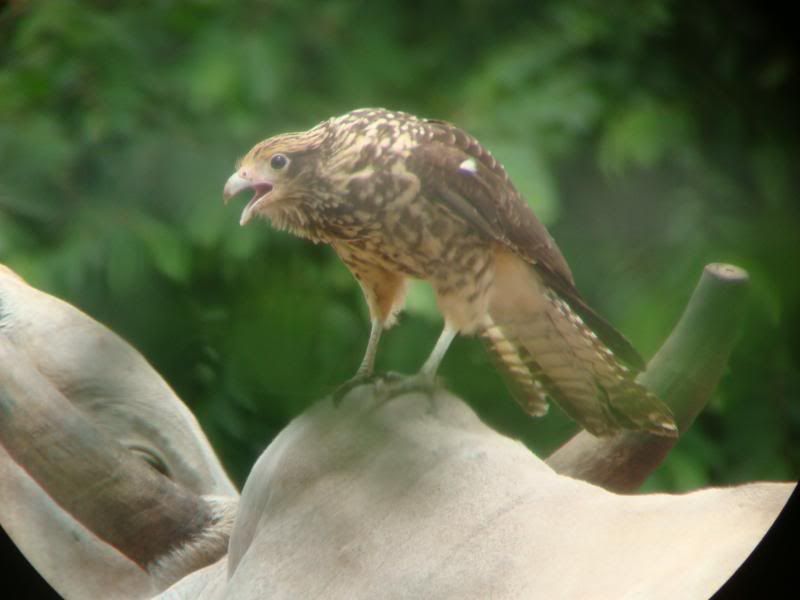
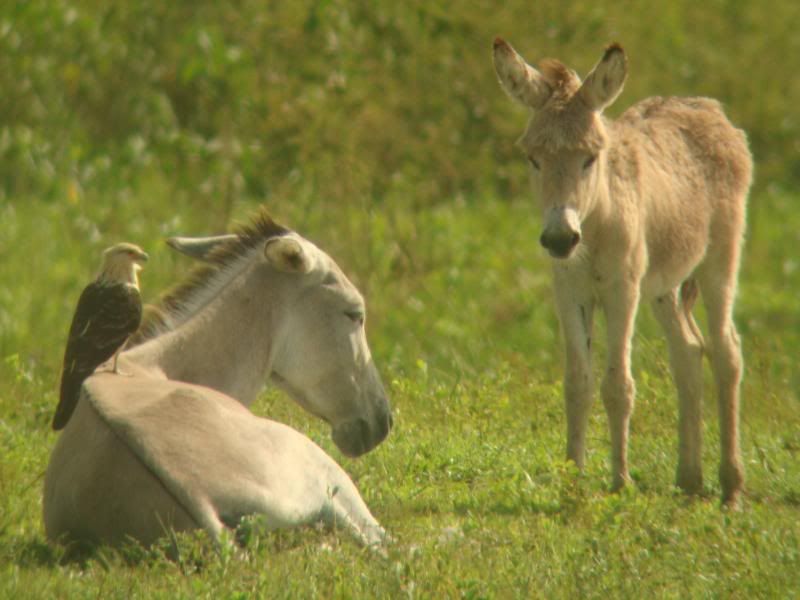
In the Venezuelan llanos and elsewhere in South America, Cattle Egrets are not alone in their mammal-following habits. They are joined by a rather unlikely mammal-lovers - the Yellow-headed Caracara (Milvago chimachima), a member of the family Falconidae. It seems odd to see a mid-sized raptor hunting insects around mammals, yet they are frequently spotted using cattle for a perch as they watch for kicked-up prey. They also readily provide the cattle with deticking services.

Juvenile (top) and adult (bottom) Yellow-headed Caracara (Photos courtesy of Rae Okawa)

Yellow-headed Caracara ticking (video courtesy of Rae Okawa)


The Caracara and Egret have nothing on the third common mammal-lover of Hato Masaguaral (and real subject of this post). This fearsome bird leaves cows trembling, horses whinnying, and pigs quaking with fear - it is the mighty Cattle Tyrant (Machetornis rixosus).


Okay, so they're not really that imposing, but don't they deserve a little recognition for their awesome despotic name?

In North America, tyrant flycatchers (Tyrannidae) are represented by such drab look-alike birds as Empidonax flycatchers, phoebes (Sayornis), and pewees (Contopus). In Central and South America, Tyrannids explode in species numbers, morphological and color diversity, and ecological habits. The Cattle Tyrant is one of the flycatchers that has adapted to open habitats and is particularly fond of the mutalistic mammal-loving foraging style. They don't just stick to their namesake - they freely exert their will over horses, pigs, capybara, and anyone else weak enough to subjugate.

This trio of dictators kept me entertained one afternoon as they directed their hog peon to forage this way and that.


Cattle Tyrants are the only member of their genus, Machetornis, and belong in the tyrannine clade of flycatchers - the 'true tyrants' (Ohlson et al 2008). Other members of this group include the familiar kingbirds (Tyrannus) and the diverse assemblage of kiskadees (Pitangus) and what I refer to as the 'kiskadee-patterned' flycatchers (Myiozetetes, Megarhynchus, etc) that are common and widespread in the neotropics. Machetornis does show shape and pattern affinities with the tyrannines, including the presence of a hidden colorful crown patch:

Cattle Tyrant orange head patch just visible

Lesser Kiskadee (Philohydor lictor) yellow head patch

With pressure from their tyrannid overlords and the constant nipping from egrets and caracara, it's no wonder that sometimes the cattle break under the strain.


References

Ohlson J, Fjeldsa J, Ericson P (2008) Tyrant flycatchers coming out in the open: phylogeny and ecological radiation of Tyrannidae (Aves, Passeriformes). Zoologica Scripta 37(3):315-335.

Wednesday, February 4, 2009

Amazing Wings

One of my favorite monotypic families is the Sunbittern, Eurypyga helias, only living member of the family Eurypygidae. It looks cool, it acts cool, it has phylogenetic sublimity. So of course I was ecstatic when I finally saw one in Venezuela last fall!

A Sunbittern bathed in heavenly golden light

These guys inhabited swampy, vegetation-choked forest on the ranch. They were very skittish - I only got lucky enough to get a photo during my last week on Masaguaral. Everytime I caught a glimpse of them, it was a bird first flushing away from the trail, then perching on an obscured horizontal branch to peer back cautiously at me. They would quietly give their weird call (listen to it on xeno-canto), walk around the branch, and fly away deeper into the forest if I so much as reached for my camera bag.

Camera-shy

One time, though, an individual was feeling uppity enough to give a warning display. As it paced back and forth on its branch, it would slowly lift a wing at a time, flashing one of the coolest wing patterns out there.


Here's a closer look at that wing plumage from specimens from my ornithology class (definitely click to view a larger version).


These patterns are used in the warning display I saw, but I didn't see the full courtship display:

(image source: Wikipedia)

My friend Rae had a different experience. She somehow managed to observe multiple Sunbitterns out in the open on the ranch, getting this video as they walked around and called.

(video courtesy of Rae Okawa)


(If the embed doesn't work: link: http://s199.photobucket.com/albums/aa220/slybirdsly/Venezuela/RaeVideos/?action=view&current=MOV08980.flv)

If you're trying to figure out the Sunbittern's closest relatives or analogs among North American birdlife, there are none. The Sunbittern, as mentioned, is a monotypic family containing only one species. This family has traditionally been placed among the Gruiformes order - containing also the cranes, rails, coots, kagu, bustards, finfeet, limpkin, trumpeters, and others. Recent molecular work has shown this order to be a polyphyletic assemblage of largely unrelated families.

Kagu (image source: Wikipedia)

The Sunbittern is independent of other families, showing no clear, close relatives except one - the Kagu (Rhynochetos jubatos) is another monotypic family: Rhynochetidae. This is a very different-looking bird endemic to the island of New Caledonia, northeast of Australia. One trait that the Kagu does share with the Sunbittern is the spread-wing display (see my work on avian relationships here for more information).

Aren't Sunbitterns awesome? (photo by Rae Okawa)