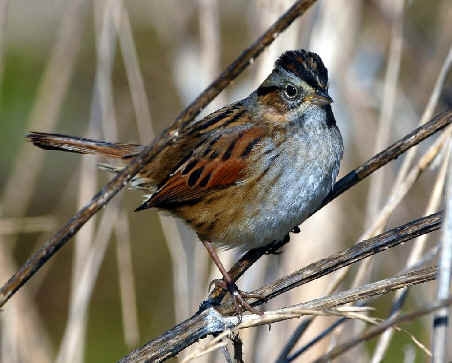
The 5th and 6th offspring from Wren and Atticora:


View my previous offspring and pictures of the parents here.

 In a paper by Russel Greenberg et al., the authors used isotope analysis of feathers grown during the winter molt to identify the previously unknown wintering grounds of a subspecies of Swamp Sparrow. The Coastal Plain Swamp Sparrow (Melospiza georgiana nigrescens) is a species of coastal marshes from
 The subspecies is visibly diagnosable by plumage: in breeding by having heavier black markings, a general gray-brown color on the flanks, lower back and rump, and a larger bill. In winter it is distinctive in its olive-brown rather than rusty-brown color, and larger bill.
Coastal Plain Swamp Sparrow
'Regular' Swamp Sparrow
(Photo source)
Feathers, when grown, can take up the isotopic signature of various elements in their environment (such as isotopes of Carbon, Nitrogen, and Hydrogen, studied here). Maps of the various isotopic gradients across the
The authors used the isotope concentrations of the rump feathers grown during the fall by the Swamp Sparrows and from male crown feathers grown from in late winter to generate an overlapping map of the three isotopes examined and narrow the likely location for the winter range of nigrescens to the coastal region of the
The authors cite one previous instance of using isotopes to identify a possible unknown winter range (Acrocephalus paludicola, Pain et al. 2004) but they believe they are the first to use isotopes to predict and then discover a population’s wintering ground. The use of isotopes often yields too coarse-grade results for useful inference, but when it succeeds the results can be very informative, as seen here.
Reference:Greenberg, R., Marra, P.P., Wooller, M.J. (2007). STABLE-ISOTOPE (C, N, H) ANALYSES HELP LOCATE THE WINTER RANGE OF THE COASTAL PLAIN SWAMP SPARROW (MELOSPIZA GEORGIANA NIGRESCENS). The Auk, 124(4), 1137. DOI: 10.1642/0004-8038(2007)124[1137:SCNHAH]2.0.CO;2
In a remarkable paper by Sora M. Estrella et al., the authors demonstrate the widespread use of a feeding mechanism in shorebirds known as surface-tension transport. The shorebirds draw a small prey item within a drop of water up the bill, without the assistance of suction or movement of the tongue. Instead, they utilize the surface tension of water to wick the droplet up to their mouth by slightly spreading their mandibles. This mechanism was first proposed and then demonstrated in the lab in Phalaropes by Rubega and Obst (1993):
If the proper balance were struck between cohesion of the drop and its adhesion to the bird's beak, progressive mandibular spreading would increase the amount of potential energy stored in the surface of the drop by increasing the free surface area of the drop. Because physical systems move to reduce potential energy (unless this tendency is opposed), the drop would move in the direction that was most likely to reduce free surface area. As long as drop positions more proximal to the gape result in smaller free surface areas and, hence, lower energy states, than those at the distal end of the bill, the drop should move toward the buccal cavity.
In other words, the droplet of water held in the bill sticks to both mandibles. As the jaws spread, the droplet is stretched out. This creates tension, which forces the droplet up the bill to reduce the distance between mandibles and the surface tension of the droplet. Rubega and Obst filmed phalaropes in the lab, using both living birds capturing prey, and specimen bills to test the mechanism and successfully eliminated tongue movement and suction as potential explanations: the dead bill still draws water drops with no tongue movement, and living birds demonstrated no throat pumping associated with sucking water up the bill.
Rubega and Obst’s laboratory studies have shown this mechanism can take less than a tenth of a second! This mechanism is discussed by both Rubega and Obst (1993) and Estrella et al. (2007) in terms of feeding efficiency, in that it allows shorebirds to feed on small prey items rapidly and with minimal energy expenditure in prey handling.
Estrella et al. (2007) extended the laboratory studies to the field, recording a total of six species in the wild (Little Stint, Dunlin, Sanderling, Curlew Sandpiper, Common Redshank, Black-winged Stilt; the study are was in Spain) adding to the four species shown in the lab to demonstrate STT (Red-necked Phalarope, Wilson’s Phalarope, Western Sandpiper, Least Sandpiper) to give a total of at least ten species in two families demonstrating this very interesting feeding method. It is very likely to be widespread in the shorebirds as a group.
This field study begans to illustrate the constraints of bill structure on the use of STT hypothesized by Rubega and Obst (1993). Estrella et al. (2007) observed Redshank and Stilt using head jerks to assist the motion up the bill. The bill must gradually widen towards the head for STT to work, and the authors note that Redshank and Stilt have fairly uniform narrow bill widths along their length.
Interestingly enough, their data shows variability by species in time per cycle (one opening movement of the bill, several cycles necessary to draw all the way up the bill) but the overall total transport time per prey item does not vary according to bill length. This indicates internal bill morphology dictates differences in STT function between species, not overall bill length.
This is a fascinating feeding mechanism that I was previously unaware of. With the demonstration by Estrella et al. (2007) of surface tension transport’s widespread use in the field, the door is open for many more novel and interesting studies on bill morphology and foraging bioenergetics with shorebirds.
Finally, go here for some truly excellent photography of shorebirds demonstrating STT.References:
Margaret A. Rubega and Bryan S. Obst. 1993. Surface-tension feeding in phalaropes: discovery of a novel feeding mechanism. The Auk. 110(2): 169-178. April 1993. (PDF)
 Another interesting paper in this October's Auk is Emily DuVal's characterization of the displays and call types of the Lance-tailed Manakin (Chiroxiphia lanceolata) of southern Central America. Manakins (Pipridae) are known for the elaborate displays of males on lek. Some species (Club-winged Manakin) even have modified wings to produce structure buzzing and clicking sounds in display.
References:
Emily H. DuVal. 2007. Adaptive advantages of cooperative courtship for subordinate male lance-tailed manakins. American Naturalist. 169: 423-432. April 2007.
Emily H. DuVal. 2007. Cooperative display and lekking behavior of the Lance-tailed Manakin (Chiroxiphia lanceolata). The Auk 124(4): 1168-1185. October 2007. (Abstract)