Showing posts with label Conservation. Show all posts

Tuesday, March 2, 2010

The Ivory Colored Frost Lover

Saturday, 20-Feb-2010: Pat Jones, birder from Long Island, discovers an adult Ivory Gull on Lake Champlain, on the Vermont side, while searching the area for a previously reported Northern Hawk Owl. During his trip to the northern reaches of New York, Pat Jones also found an adult male Tufted Duck, in addition to the continuing Northern Hawk Owl, making for an incredible northern New York rarities trifecta.

As the reports of the Ivory Gull continued through the following week, schemes began to form for a trip to the northeast corner of New York State. A major winter storm that hit Ithaca Thursday night almost thwarted our attempt. Not wanting a repeat of our first Ivory Gull chase in January of 2009 where we drove through the middle of a blizzard, we watched the weather intently. However, the storm passed, and the roads were cleared by midday on Friday.

By Friday afternoon, plans were made to leave Ithaca at 3:30 the following morning. A second group of Ithaca birders left earlier that day, and were able to track down the gull on Friday afternoon.

Now, I was going out to dinner with friends the night before, and didn’t get back until late, so I had the bright idea of not sleeping before leaving. That, in the long run, hurt, but, all went well enough. After an early start, Tom, Carolyn and I were on our way, first to pick up Brad, and then to Ausable Point, first to track down the Tufted Duck. Arriving at Ausable Point around 9 AM, we quickly saw the Tufted Duck, pointed out to us by our fellow Ithacans who had found it earlier in the day. Now, I can understand that part of the appeal of Tufted Ducks is that they are a rare bird for us U.S. birders, but I really do enjoy watching them. Their tuft is actually quite loose, and flops around a lot as they swim, turn their head, and dive. When resurfacing, their tuft, initially plastered to their head with water, suddenly springs back out.

My poor attempt at digiscoping the Tufted Duck. In this picture, it is pretty close to center and sleeping. You can pick it out by its black back and clean white sides

After we finished watching the Tufted Duck, we moved on to the Ivory Gull. As soon as we arrived, the dozen or so birders that were already gathered on the jetty pointed out the bird to us. At first, the bird remained quite distant on the ice for quite a long period of time, seemingly content with bathing, preening, sleeping, and pooping. We waited on that break wall for a good 4 hours, with intermittent snow squalls making our vigil particularly painful. But, we were rewarded for our patience, as the bird eventually got hungry, and came into a chicken carcass that was on the ice near the jetty. It fed on the chicken for nearly 45 minutes while we just stared in amazement at its beauty.

Views from the Rouses Point jetty, where we spent close to five hours watching the Ivory Gull. Note the ice fishermen on the ice in the middle picture.

Sitting through a brief snow squall while watching the Ivory Gull (photo by Carolyn Sedgwick)

The Ivory Gull begins to close in on some tasty chicken

When not feasting on this chicken, this Ivory Gull would pick at fish that the ice fishermen had left out for it

Adult Ivory Gull, Rouses Point, NY.

Ivory Gull going for a stroll on the ice after gorging on chicken

After we had our fill of the Ivory Gull (not that I can ever tire of that bird), we moved onto the Northern Hawk Owl, which had been spotted earlier in the afternoon after a two-day hiatus, for our final twitch of the day. Again, we were not disappointed, as the bird sat on the side of the road, and at one point caught a vole, which it later cached somewhere. Unfortunately, by that time of day, the light was poor, and my camera refused to cooperate.

Northern Hawk Owl, Champlain, NY.

Probably one of my best birding days in New York state (from a rarities perspective), this day was tempered by the thought that this adult Ivory Gull may only be here due to changes in its northern realm. Over the past two winters, an unprecedented number of Ivory Gulls (mostly adult birds, no less) have shown up on the East Coast, one making it as far south as Georgia (roughly 10 birds south of the Canadian border). Typically, vagrant birds are juvenile birds, but the sudden surge of adult vagrants this far south raises questions of the quality of the traditional winter grounds. In the Canadian Arctic, Ivory Gull populations appear to be declining quite rapidly (based on surveys at the breeding colonies), with climate change thought to be one of the primary factors (Mallory et al. 2008). In addition to changes due to climate, Ivory Gulls have been found to have increasing levels of pollutants in their bodies, with high amounts of mercury and other pollutants (Birdlife International 2010)

For a few more pictures of mine, plus a video of the Ivory Gull feeding, check here.

For much better pictures of the Ivory Gull and Northern Hawk Owl, check out Tom's pictures here and here.

References:

Mallory, Mark L., Iain J. Stenhouse, Grant Gilchrist, Gregory Robertson, J. Christopher Haney and Stewart D. Macdonald. 2008. Ivory Gull (Pagophila eburnea), The Birds of North America Online (A. Poole, Ed.). Ithaca: Cornell Lab of Ornithology; Retrieved from the Birds of North America Online: http://bna.birds.cornell.edu/bna/species/175

Tuesday, February 2, 2010

Conservation, Paper Subdivisions, and the Google Age

I've been recording Florida Scrub-Jays recently on various sites on the Lake Wales Ridge. I had an interesting experience today trying to make connections between my google maps printouts, my map of the scrub and reserve boundaries, and my on-the-ground field-truthing of where these jays are. My target today was to record every jay in Silver Lake, a scrub reserve that is part of a network of protected areas on the ridge (see map). Here is the Google roadmap of the protected area, most of the area you see north of Columbus Boulevard and Minorca St:


Basically, besides the patch west of Silver Lake itself, it looks like all subdivision! Zooming in farther, the roads even all have names:


Now click from street map to satellite view and turn off the labels. Poof! Roads gone! It looks like a subdivision slated for development made it as far as being uploaded to Google Maps before being bought up for scrub conservation. Then I realized what a common pattern this is in Florida conservation. I couldn't be happier to never see those roads developed. We have too many already.

More depressing is the land not currently protected. Go ahead and click the "Show Labels" on Sat View on and off. Watch the habitat magically disappear!


If that makes you too depressed, like it did me, I checked around and it does look like that parcel is actually targeted for conservation acquisition. Check Appendices 2 and 3 under the "State of the Scrub" report here and search for the Silver Lake properties.

I've encountered other sites like these in my fieldwork in Florida over the past year. Here is a section of another one of these protected sites, Carter Creek. Unlike Silver Lake, this paper subdivision got as far as clearing lanes through the flatwoods and scrub for the roads. There are even a few holdout land parcels with houses scattered through it. Check it out, switch the labels on and off again:


My current work on the Bombing Range sometimes takes me up to another paper subdivision, this one with a very different history. That story was featured, not particularly kindly, in a book, Redneck Riviera. Basically the roads were never cleared (never even intended to be cleared, if you believe the stories in the book), and it is now under the governing of the River Ranch Property Owners Association. There is a big swath of land dedicated to setting up camp or RV or trailer, and an enormous tract of undeveloped land used for lots and lots of hunting. While it may be criss-crossed by an insane maze of ATV and 4wd and swamp buggy tracks, I don't think this is a particularly bad end for a paper subdivision. Some of the camps get really redneck, which makes working there fun:


Finally, last spring Eric and I, on a herping trip through south Florida, briefly visited the big granddaddy of all paper subdivisions: Picayune Strand. Read that link for the backstory.


It was a bit of a shock while roadcruising to pop out the back end of Fakahatchee Strand Preserve (that road coming through the wilderness on the right) and into a maze of cleared dirt roads and canals. These road scars through the state forest are easily visible on the zoomed-out satellite view, and they also have names in Google Maps, if you zoom in and turn the labels on.

Is this a uniquely Floridian conservation strategy? I can't recall encountering anything like this in New York, but then upstate NY isn't besieged by swarms of retires looking for nice gated communities.

Edit, postscipt:

I came across a relevant quote in the old Pat McManus book I've been re-reading:

"City planners have shown beyond doubt that old orchards, meadows, and pine woods, which once threatened the outskirts of many of our towns and cities, can be successfully eradicated by constructing a housing development on top of them. To my knowledge there has not been a single recurrence of an old orchard, meadow, or pine woods after one application of a housing development."
(Patrick F. McManus, "The Backyard Safari" in A Fine And Pleasant Misery)

Saturday, October 31, 2009

The Great Woodpecker Airlift


I recently defined "Endangered" as a failure to breed in sufficient quantities. That is certainly the case with Red-cockaded Woodpeckers, especially in the small isolated populations towards the periphery of their range in southern Florida. One conservation strategy to help boost these populations is translocation - stealing woodpeckers from large, healthy populations and moving them into empty clusters here, in the hope that they will establish as new pairs.

This year, our study population was slated to receive five pairs of birds from Fort Stewart, Georgia. We lucked out in receiving a ride from our commander in a small aircraft, because it would've been a marathon drive otherwise. On Thursday morning, we crammed the tiny aircraft full of ten empty Woodpecker Moving Devices, two biologists, and two pilots, and set off northward towards the Deep South.


Once on the ground in Fort Stewart, we got swished up into the huge, well-oiled operation that is their wildlife department. Our little biology station could never muster enough people or equipment to send out ten woodpecker trapping teams simultaneously! Our crew was broken up amongst the teams and sent out the door soon after the organizational meeting.

Out in the field, I got a brief taste of some real Georgia pineywoods.


My real shock came when I unfolded the map of the Fort containing all of the RCW clusters... over 400 of them! It's no wonder then that this population can be a source for little groups like ours, with less than thirty active clusters. Here there are also many more natural cavities rather than inserts. Below is much more typical of RCW trees than this insert, with lots of resin flow around the cavity.


My team waited until dusk when our cluster returned to go into roost. After some frantic minutes trying to identify the target bird and its roost, a long-handled net was placed over the cavity hole and the bird was trapped. We were going after specific birds, because only young of the year are translocated. Adults with established territories don't make good subjects for movement because they'll just leave to look for their old home.

My first RCW in the hand

Terrified RCW squeal as we check the band number

With my teams target birds in their WMDs, we waited back at base for everyone to rendezvous. The commander got to check out some baby Gopher Tortoises and other education animals the staff had on hand.


Once all ten woodpeckers were trapped and assembled, Phase 2 of translocation could begin - we all crammed back in the plane and flew back south. Sometime after midnight, we were on the ground and back at APAFR, where the rest of our bird lab was up waiting with coffee in hand. We divvied up the pairs of birds amongst the teams and went out to place them in their new clusters. Each pair gets placed in an empty cluster, with each bird getting put in its own insert. The inserts are then screened off for the night to allow the bird to settle in.

Field work by the light of the moon, circa 3am

Unfortunately, the squeals of a terrified woodpecker brought in an uninvited guest.


We shooed the Barred Owl away, and made sure the woodpeckers were securely screened inside the cavity where they were safe for the night. We also made sure no raptors lurked nearby when we returned at dawn for release. I assure you no woodpeckers were made a snack (at least not before they were flying free and out of our sight - then its not our responsibility).

Pulling on the string to yank the screen cover off

At dawn, after a mere 2 hours of sleep for our crew, we returned to all of the new clusters and yanked down the screens. The new RCWs bolted out and got adjusted to their new homes. Since each pair was actually a young male and female from different families and thus strangers, we watched to see if they would show any interest in each other. In fact, hardly anyone got the cold shoulder, and the hopefully soon-to-be new pairings moved off to forage and face the harsh new world of south Florida together.

Monday, October 26, 2009

Building New Homes for Endangered Woodpeckers

A Step-by-Step Guide (but don't try this at home)

Red-cockaded Woodpeckers (Picoides borealis) are unusual among woodpeckers (perhaps even unique? Can anyone name any other examples?) in that they nest exclusively in living pines, most notably Longleaf Pines (Pinus palustris). The cavities are difficult to excavate into hard, sappy wood and can take a very long time to complete. A typical RCW cluster will have a breeding pair and maybe some helpers (young from previous years that stick around to help) so a cluster requires many cavity trees for roosting and nesting within their territory.

Therefore, if conservation management wants to supplement an RCW population, you can't just throw them in a good-looking patch of pineywoods and expect them to magically drill roost cavities overnight. The solution is nest-boxes, but with the added twist of getting them inside the tree. By adding these inserts to woodpecker clusters, the RCWs quickly get a new home that they can use as a base while they drill their own. They also adapt quite easily to using the inserts as their nest cavities. So, here's a photo essay on how a bird nest box gets placed inside a living pine tree. An alternative title to this post might well have been "Chainsaws for Conservation!"

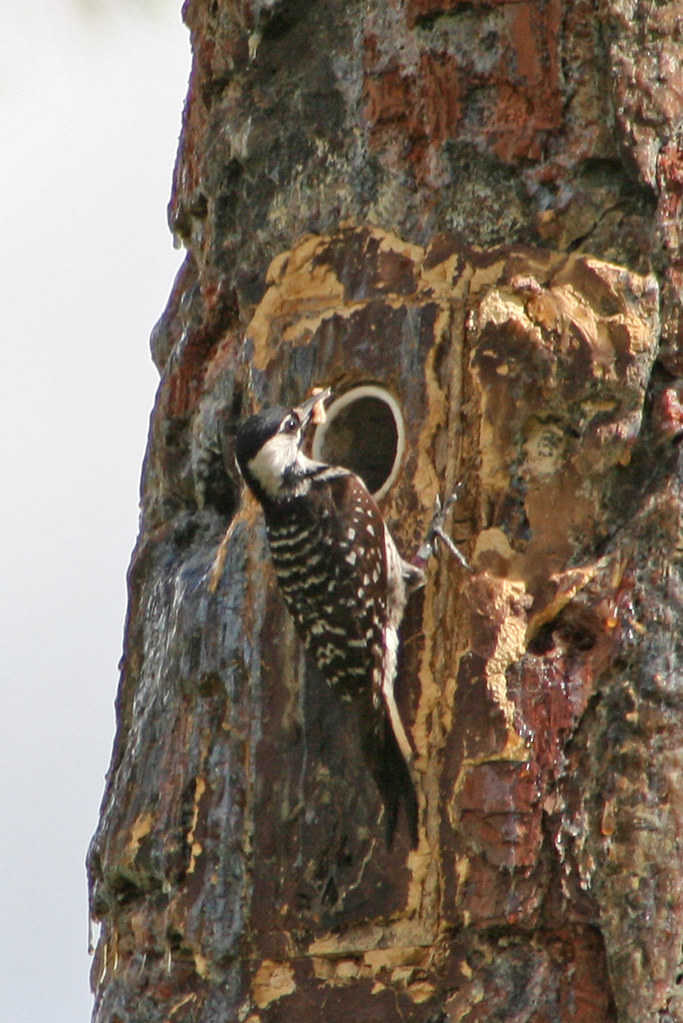
Picoides borealis bringing food to a nest in an insert (photo by Travis Wilcoxen)

This is an insert, ex-situ. Its just like any other nest box, although tall, narrow, and deep. Also, the front is reinforced with a metal grid and the entrance hole is a PVC or metal pipe, to help prevent the insert from being blown out by other woodpeckers looking for an easy home to steal. A cutaway view shows an ugly woodpecker chick in the nest chamber.


So, to shove this insert inside a tree. Step 1 - gather your resources (chainsaw, wood putty, spray-paint, and the insert) and climb the tree.


Size up the insert


Then slice and dice!


Cut the block up into chunks and start ripping them out


I'm no tree-ologist, but this pine looks approximately 25 years old, kinda young.


The tree has to be big enough so you don't cut more than half-way... wouldn't want the tree snapping off now would we?


I've heard that our trees in south-central Florida are puny compared to those 'up north'.


So, now that the hole is cleaned out, does the insert fit? Nope, not quite yet.


Get in there with a chainsaw for some fine detail work to make that insert fit.


Now it fits! Lather on some peanut butter wood putty and slide that baby right in there.


Still doesn't fit? Good thing you brought your trusty hammer!


Great! Now to give it that rustic look, lather on some more putty and paint it up


All finished! Now you have a fully-functioning woodpecker home, ready for occupancy!