The July issue of The Auk contained the AOU North American Checklist Committee's
51st supplement to the AOU checklist (pdf), a variety of splits and changes to taxonomy at the genus level and higher. Sibley handily
summarizes the name changes to North American species, and Michael Retter
reviews the whole supplement, and I'm sure it has been plastered elsewhere on the blogosphere by now so I am not going into a full review here (plus, I
blogged about one of the splits two years ago - everyone else is late to the party). Instead, I'm breaking my long self-imposed blog exile to talk about warblers. Actually, mostly about warbler names.
The 51st supplement makes two changes to genera in New World wood-warblers (Parulidae): the waterthrushes are split from the Ovenbird (
Seiurus) and placed in a new genus,
Parkesia, and most of the genus
Vermivora is split and removed into a new genus,
Oreothlypis . These changes are based on results that have been in the phylogenetic literature for some years now, but have not resulted in comprehensive taxonomic updates. While Klein et al. (2004) presented a phylogeny for the family and documented many problems with generic limits, they did not present many taxonomic solutions and their sampling of the diversity of Central and South American Parulids was very slim. In general, while there have been several papers addressing phylogeny in the overall family (Klein et al 2004, Lovette and Hochachka 2006) and in certain groups (
Dendroica: Lovette and Bermingham 1999;
Myioborus - Perez-Eman 2005;
Geothylpis and
Oporornis - Escalante et al. 2009), a comprehesive phylogeny of the group with solid sampling of species (there are over 110 in the whole family) and a complete update of Parulid taxonomy has been lacking ... (drumroll)... until now.
Lovette et al. (2010) present a comprehensive picture of the evolution of the wood-warblers, sampling all but three species and addressing the phylogenetic analyses with a good array of loci and methods. Their main result is a phylogenetic hypothesis for comparative studies and a proposal for complete revision to generic boundaries. I just want to step through the warbler tree and possible taxonomic disagreements as a guide for when taxonomic authorities eventually get to addressing them.
Phylogeny of the Parulidae (Fig. 5 from Lovette et al. 2010) with proposed taxonomic changes. You'll definitely want to click to enlarge and read

Parulidae is a large family with ~110 species concentrated in several large genera, but the early branches of the tree are composed of 7 different species-poor lineages. The first branch in the tree is in all analyses the Ovenbird (
Seiurus aurocapillus) - the dull, chunky warbler of forest floors in the Eastern US. Other lineages represent monotypic genera, the odds and sods of the Parulidae that have been recognized as distinct - the Worm-eating Warbler (
Helmitheros vermivorus), Black-and-White Warbler (
Mniotilta varia), Prothonotary Warbler (
Protonotaria citrea), and Swainson's Warbler (
Limnothlypis swainsonii). The final two lineages in this group represent some of the generic reassignments already made by the AOU. The Northern (
noveboracensis) and Louisiana (
motacilla) are moved from the genus
Seiurus, which they shared with the Ovenbird (a relationship that never made sense to me, given how different they are in plumage and habits), to their own genus,
Parkesia (created for them by Sangster 2008). Three species of
Vermivora - Bachman's (
bachmanii), Blue-winged (
pinus, now
cyanoptera), and Golden-winged (
chrysoptera), are found to not be closely related to the remaining members of the genus. These lineages are all found in Eastern North America, but represent a variety of plumage and ecological specializations. The exact relationships among them change depending on analyses (except the placement of Ovenbird at the base of the tree), but it is clear that they are all old and distinct, and I don't foresee anyone attempting to lump some of these monotypic genera.
Worm-eating Warbler (
Helmitheros vermivorous) from
Wikipedia
The remaining members of what was
Vermivora - Tennessee (
peregrina), Orange-crowned (
celata), Colima (
crissalis), Lucy's (
luciae), Virginia's (
virginiae), and Nashville (
ruficapilla) - get their own branch of the warbler tree. These ex-
Vermivora are a pretty cohesive and closely related group - they are all North American, either greenish (northern and eastern species) or grayish (southwestern species), most with an orange or rufous crown patch and yellowish vent. However, they share their branch with two oddballs - Crescent-chested Warbler (
superciliosa) and Flame-throated Warbler (
gutturalis), formerly in the genus
Parula. Both of those are Central American species with plumage very similar to that of Northern and Tropical Parulas, Crescent-chested especially -
check this photo out - but
Flame-throated is a bit more distinctive and I'm not surprised it is not related to other Parulas.
The ex-
Parula group is pretty closely related, the ex-
Vermivora group is pretty closely related and the two groups are each others closest relatives on the big warbler tree, but already opinions differ on how to assign new genus names. Sangster (2008b) saw this result in earlier phylogenetic literature and took the step of naming each group separately - Crestent-chested and Flame-throated Warblers get the resurrected genus name
Oreothlypis, and the ex-
Vermivora get a newly created genus name
Leiothlypis. Lovette et al. (2010) decided to give a genus name to the whole group, meaning
Leiothlypis gets subsumed by
Oreothlypis as the name for the group. The AOU voted the same way in the 51st supplement, merging all eight taxa into
Oreothlypis, with
many of the voters citing one genus as marginally better than two, even though it is totally arbitrary. I personally think keeping
Leiothlypis and
Oreothlypis as separate makes more sense, given their distinctiveness from each other, but both options are valid.
Lucy's Warbler (
Oreothlypis luciae) from
Wikipedia
The next branch in the warbler tree contains the yellowthroats (
Geothlypis), species found throughout the New World united by black masks and another feature you might never guess from their name, the gray or black hooded North American warblers in the genus
Oporornis, and an unusual, little-known, likely extinct species endemic to St. Lucia in the Lesser Antilles - Semper's Warbler (
Leucopeza semperi). However, generic limits are all mixed up in this group, necessitating change. There is a tight-knit little group of closely-related yellowthroats, including the widespread Common (
trichas) and the similar Belding's, Bahama, Altamira, and Hooded, and the slightly more distantly related Olive-crowned and Black-polled. Their closest relative is not, however, other yellowthroats but instead Kentucky Warbler (
Oporornis formosus), which with its black mask and yellow underparts looks more like a yellowthroat than the other
Oporornis anyway. The two gray-hooded species, Mourning and MacGillivray's, are closest relatives (and a hybrid zone has recently been described in Canada), but instead of being closest to the other gray-hooded species, Connecticut, they are related to two more unusual yellowthroats - Masked (
aequinoctialis, which may actually be a species complex) and Gray-crowned (
poliocephala). The two final species in this group are old, distinct genetic lineages - Connecticut (
agilis) and Semper's Warbler. Escalante et al. (2009) and Lovette et al. (2010) both choose, because of how mixed up the traditional genus limits are, that it makes most sense to contain this whole group within one genus -
Geothlypis has priority. An alternative treatment has already been made by John Boyd's
TiF Checklist - he retains
Leucopeza, allows Connecticut to retain the genus
Oporornis, and leaves the rest as
Geothlypis. I also tend to prefer retaining
Leucopeza for the very distinctive Semper's Warbler, but Connecticut isn't all that different from others and I'm not sure it should get its own genus. I guess I'm undecided on this point.
Gray-crowned Yellowthroat (
Geothlypis poliocephala) from
Wikipedia
Masked Yellowthroat (
Geothlypis aequinoctialis) from
Wikipedia
The remaining warblers - fully two-thirds of the diversity of the family - form two broad groups. One contains almost all the remaining North American species, mainly the bright colorful migratory species in
Dendroica that are what most come to mind when wood-warblers are mentioned. The other contains almost all warbler diversity in Central and South America in several distinct genera.
The North American
Dendroica radiation of warblers is pretty amazing - they are the eye candy of the family. They underwent an early burst of speciation that declined through time, likely as ecological niches were filled. They have diversified to the extreme in plumage (and to a degree in song as well), so much so that virtually no plumage characters unite them, but they have not diversified much morphologically. This may constrain them ecologically, but they also adapt by behaviorally partitioning their ecological niches - the subject of some classic ecological studies. Check out this
poster on the North American members of the group. Lovette et al. (2010) confirm earlier phylogenetic studies that
Dendroica represents one big cohesive group. However, taxonomic changes come from other species found nested within the genus. The American Redstart (in the monotypic genus
Setophaga), the two remaining
Parula - American (
americana) and Tropical (
pitiayumi) - and the Hooded Warbler (
Wilsonia citrina) are all firmly embedded within
Dendroica. The strange Whistling Warbler (
Catharopeza bishopi) -
seen here - from St. Vincent in the Lesser Antilles is also closely related to this radiation, but represents the earliest branch. Lovette et al. (2010) choose to rename the whole group into one genus -
Setophaga has priority, unfortunately removing the name
Dendroica associated with much of the literature on the group. I agree with this move, except perhaps on lumping
Catharopeza in with the rest. I like minimizing taxonomic changes necessary, and the position of
Catharopeza as the oldest branch does not mandate that it be lumped in with the rest of the group. It is pretty unique in plumage, but on the other hand, few species in
Dendroica look alike - it is their heterogeneity that unites them. John Boyd has taken an alternative approach to the taxonomy, choosing to preserve all of the other genera that were found lumped within
Dendroica. This necessitates making some odd changes - three West Indian Dendroica (Arrow-headed (
pharetra), Plumbeous (
plumbea), and Elfin Woods (
angelae)) would require their own new genus to be described, and Kirtland's (
kirtlandii), Cape May (
tigrina) and Cerulean (
cerulea) would need to be lumped into
Parula to preserve that genus. I completely disagree with this approach - it creates much more taxonomic change than the alternative, it relies on the exact branching pattern of species within the overall group which is likely to change depending upon the analysis, and I see no real distinctiveness to these genera - especially the bizarre new
Parula.
Cerulean Warbler (
Setophaga cerulea) from
Wikipedia
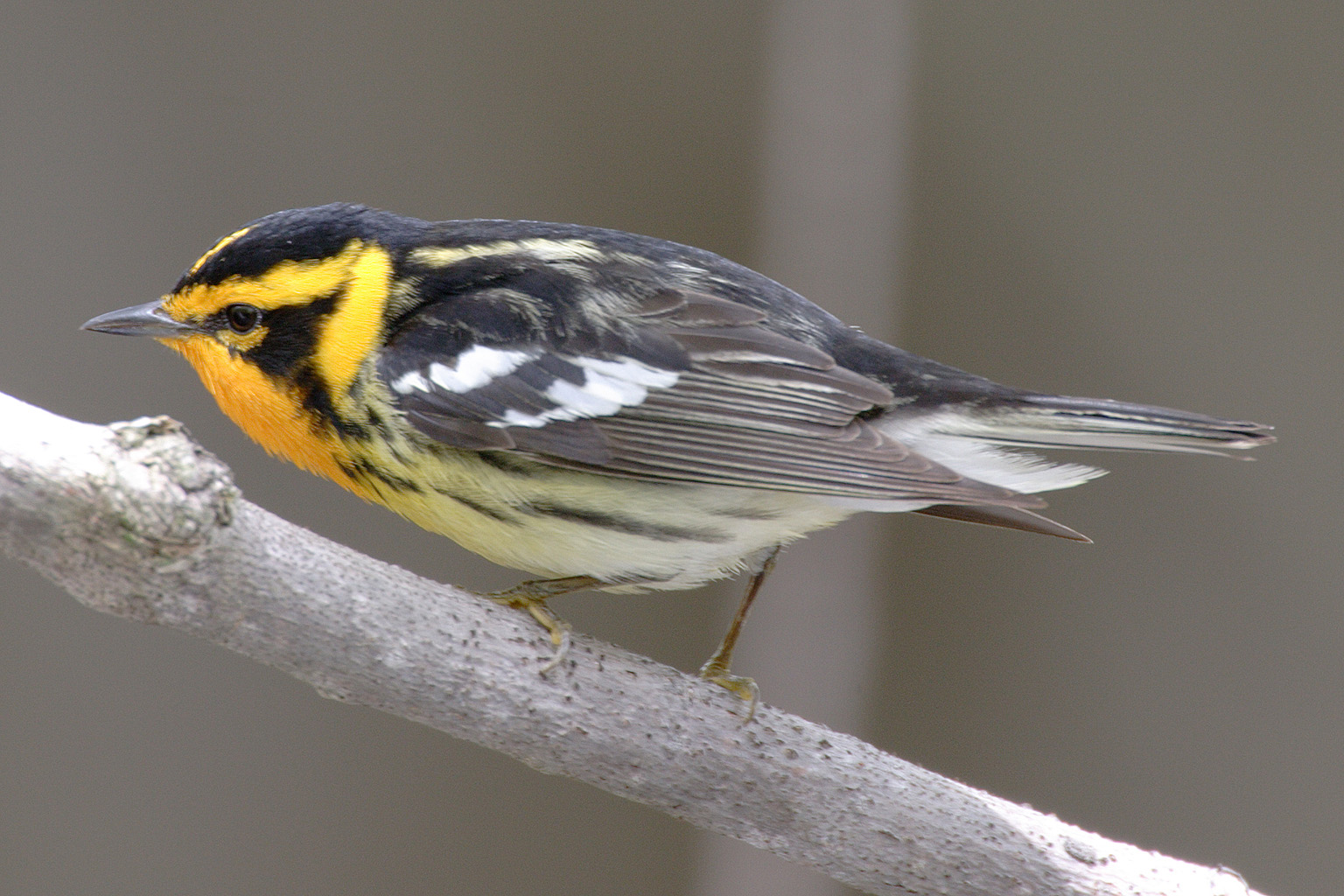
Blackburnian Warbler (
Setophaga fusca) from
Wikipedia
Most warbler diversity in the Neotropics falls within a large genus,
Basileuterus. While containing almost as many species as the newly expanded
Setophaga, plumage in this genus is much more conservative, consisting most often of yellow underparts, green or grayish upperparts, and striping on the face. Lovette et al. (2010) find that
Basileuterus is actually two distinct groups occupying different portions of the tree, and it needs to be split into two genera. One group is primarily South American species, and also includes embedded within it two species often given their own genus
Phaeothlypis - River Warbler (
rivularis) and Buff-rumped Warbler (
fulvicauda).
Phaeothlypis is merged into this genus and the South American group is given the resurrected genus name
Myiothlypis. The other clade of
Basileuterus retains that genus name and consists mostly of Central American species with a few closely related South American forms. In with the new reduced
Basileuterus clade is the Fan-tailed Warbler, often split as its own genus
Euthlypis lachrymosa. It represents the earliest branch in
Basileuterus, and like
Catharopeza could continue to be recognized because taxonomic change is not abolutely necessary, but Lovette et al. (2010) include it in
Basileuterus.
Black-crested Warbler (
Myiothlypis nigrocristatus) from
Wikipedia
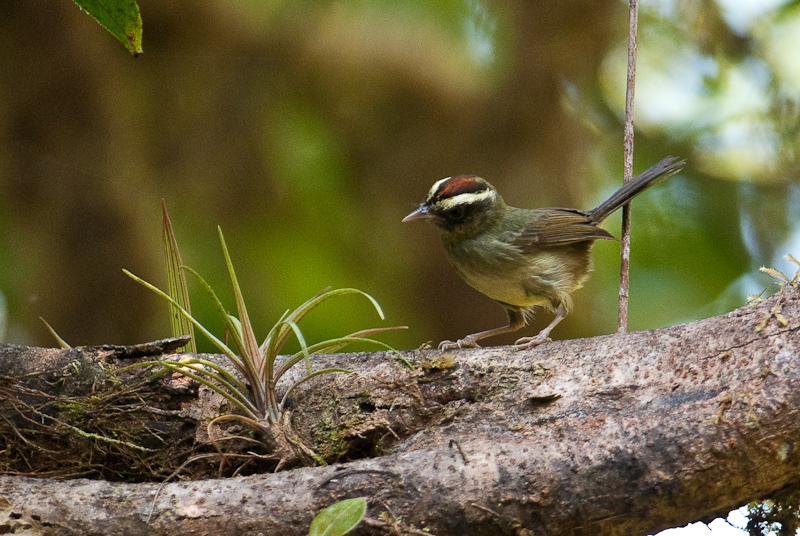
Pirre Warbler (
Basileuterus ignotus) from
Wikipedia
Buff-rumped Warbler (
Myiothlypis fulvicauda) from
Wikipedia
The final two Neotropical lineages are related to
Myiothlypis. One lineage is the redstarts/whitestarts in the genus
Myioborus. This is actually the only large genus in the Parulidae not affected by taxonomic changes. The other lineage contains a motley assortment - Canada Warbler (
Wilsonia canadensis), Wilson's Warbler (
Wilsonia pusilla), Red-faced Warbler (
Cardellina rubrifrons), and the two reddish warblers in
Ergaticus: Red (
ruber) and Pink-faced (
versicolor). A close relationship between
Cardellina and
Ergaticus is hardly surprising: these species are some of the only warblers to utilize bright reds in their plumage, and they are all restricted to Mexico and adjacent areas. The inclusion of two
Wilsonia species here is bizarre - the genus never made any sense to me, but I expected them all to be thrown in with
Dendroica. Instead, it looks like two species from the broad Neotropical radiation of warblers have reinvaded North America, become migrants, and are perhaps as similar to some
Dendroica in plumage as they are to Neotropical species. As weird as this group appears, Lovette et al. (2010) lump
Ergaticus,
Cardellina, and the two
Wilsonia into one genus -
Cardellina has priority. The alternative, retaining
Ergaticus, would necessitate the creation of two new monotypic genera for Wilson's and Canada Warblers - not really a very desirable solution.
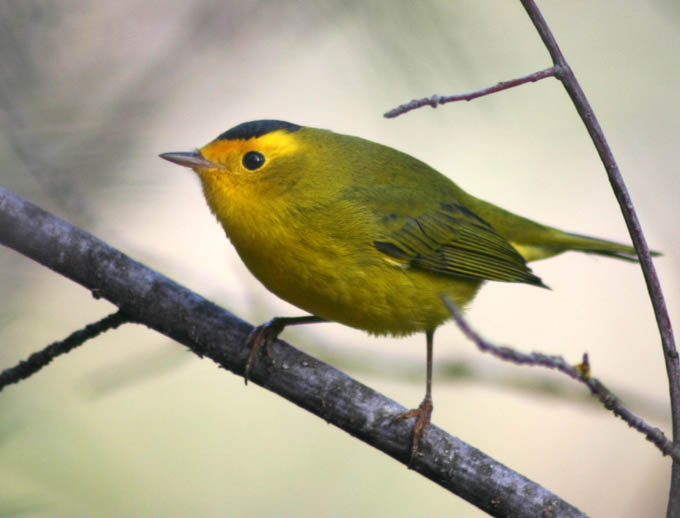
Wilson's Warbler (
Cardellina pusilla) from
Wikipedia
Red Warbler (
Cardellina ruber) from
Wikipedia
Collared Whitestart (
Myioborus torquatus) from
Wikipedia
Well, that about covers Parulidae - or at least, a guide to the potentially confusing and contentious upcoming taxonomic changes in the group. I haven't even covered many problems with species limits in the group, or any of the interesting aspects of warbler biology that the phylogeny can be used to study. Maybe someday. To close, here is a summary of genera in the taxonomy of Parulidae proposed by Lovette et al. 2010:
SeiurusHelmitherosParkesia (incl. some
Seiurus)
VermivoraMniotiltaProtonotariaLimnothlypisOreothlypis (incl. some
Vermivora, some
Parula)
Geothlypis (incl.
Oporornis,
Leucopeza)
Setophaga (incl. some
Wilsonia,
Dendroica,
Catharopeza, some
Parula)
Myiothlypis (incl.
Phaeothlypis, some
Basileuterus)
Basileuterus (incl.
Euthlypis)
Cardellina (incl. some
Wilsonia,
Ergaticus)
MyioborusReferences
Escalante P, Marquez-Valdelamar L, de la Torre P, Laclette JP, and J Klicka (2009) Evolutionary history of a prominent North American warbler clade: the Oporornis-Geothlypis complex. Molecular Phylogenetics and Evolution 53:668-678
Klein NK, KJ Burns, SJ Hackett, and CS Griffiths (2004) Molecular phylogenetic relationships among the wood warblers (Parulidae) and historical biogeography in the Caribbean basin. Journal of Caribbean Ornithology 17, 3-17
Lovette IJ and E Bermingham (1999) Explosive speciation in the New World Dendroica warblers. Proc R Soc Lond B 266:1629-1636
Lovette IJ and WM Hochachka (2006) Simultaneous effects of phylogenetic niche conservatism and competition on avian community structure. Ecology 87(7):S14-S28
Lovette, I., Pérez-Emán, J., Sullivan, J., Banks, R., Fiorentino, I., Córdoba-Córdoba, S., Echeverry-Galvis, M., Barker, F., Burns, K., & Klicka, J. (2010). A comprehensive multilocus phylogeny for the wood-warblers and a revised classification of the Parulidae (Aves) Molecular Phylogenetics and Evolution DOI: 10.1016/j.ympev.2010.07.018
Perez-Eman JL (2005) Molecular phylogenetics and biogeography of the Neotropical redstarts (Myioborus; Aves, Parulinae). Molecular Phylogenetics and Evolution 37:511-528
Sangster G (2008a) A new genus for the waterthrushes (Parulidae). Bulletin of the British Ornithological Club 128:212-215.
Sangster G (2008b) A revision of Vermivora (Parulidae) with the description of a new genus. Bulletin of the British Ornithological Club 128:207-211.