Showing posts with label Books. Show all posts

Tuesday, October 26, 2010

Review: Parrots of the World

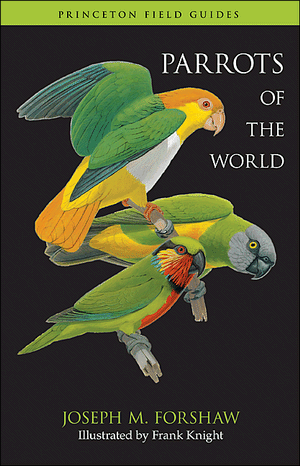
I recently received a review copy from Princeton University Press of Parrots of the World by Joseph Forshaw (amazon), which as the name implies covers all 350+ species of parrots in the world. This is a condensation of his early guide, Parrots of the World: An Identification Guide, designed as a typical field guide with an illustration plate on the right and brief text descriptions and range maps on the left. This redesign ends up being about the dimensions of the big Sibley guide but 2/3 of the length, so it is fairly suitable as a field guide, as it is marketed. However, I see little niche for world-spanning family guides as an actual in-the-field tool in my future birding - it would only be relevant for at most a couple dozen species out of hundreds on a trip to the neotropics, for example. However, I think this makes its niche as a light, cheap reference guide to the parrots, relative to its bigger and costlier parent book (although I have not seen this book in person to compare or to know how much information has been lost), so that is the angle I approach this review from.

Overall, I think the book is gorgeous, and succeeds thoroughly as a reference to the Psittaciformes. The illustrations are generally excellent and lifelike, although a few are depicted not in life poses but instead front/back views of museum specimens, presumably for subspecies for which little material is available to study. Illustrations average around 3 species per plate, so with the dimensions of the book each bird is fairly large. Some plates feel a little empty with too few spaced out illustrations, and I think a few more similar species on plates together is generally better for comparison, but in most places the book succeeds in balancing the number of illustrations per plate with illustration size. Similarly, the range maps are well sized, with my only major complaint is the complete lack of country boundaries on continents. This is balanced by brief notations in the text about range and localities to see the species, but boundaries would have been a simple, beneficial addition.

One major highlight of this book for me is the treatment of subspecies. Ranges of all subspecies are depicted on the maps and all are briefly described in the text, and many subspecies receive their own illustrations. In a few extreme cases this leads to a species like Rainbow Lorikeet taking up three plates itself, but I don't see this as bad at all. The comprehensive inclusion of subspecies is so critical for capturing the true range of variation in a bird family, and is also extremely helpful for understanding potential future splits.

Overall accuracy is a major benchmark for a reference work, but unfortunately I am in little position to evaluate this for most of the species in the guide. I have however spent some time birding in the neotropics, and I've even spent multiple field seasons doing research on a wild population of Green-rumped Parrotlets (Forpus passerinus). So, to check accuracy of course the first thing I did was flip to this genus. The illustrations for F. passerinus were a little disappointing for me - the overall structure of these birds is very accurate but there are subtle details in the plumage they got wrong. The male F. p. passerinus is accurate except they tend to have a slightly grayer wash on the nape. The female though definitely does not show such a distinct green face mask like the male as illustrated and instead has a variable yellow wash in the front of the face.

A pair of Green-rumped Parrotlets - male on the upper post. You know they had to make it into this post somehow!

Another major plus for this guide is the inclusion of flight illustrations, both upper and lower surfaces, for the majority of species. This is such an excellent feature I do not really know why its inclusion was not 100% comprehensive. A large number of my neotropical parrot sightings consist of birds flying past - such as slow, raucous pairs of Amazona or noisy rapid flocks of parakeets - so when country field guides fail to depict flight shots well they put birders at a disadvantage to identifying parrots. Also to this end the guide includes a neat figure in the introduction identifying many parrot genera by silhouette via their distinctive shapes.

The flipside to this is that Parrots of the World gets these distinctive flight profiles wrong for major Neotropical genera. It depicts the stocky, broad-winged and short-tailed genera, chiefly Amazona, as having narrow, pointed wings approaching falcon-shaped in both the genera chart and in every individuals flight shots. This is just a major glaring error. Take a look at the wing shape depicted for these Pionites in this sample plate from Princeton Press - the same swept-back pointed wing is depicted for Amazona.


Now check out this or this flight shot of Amazona parrots from Flickr. I don't think this ultimately detracts greatly from the guide's usefulness as an overall parrot reference, but it could impair field identifications and is ultimately just really annoying for those familiar with these species in the field.

One final pet peeve - the frequent use of "unmistakable" as a descriptive term for many species. First, nothing is truly unmistakable. Second, some species listed as such really don't deserve it. For example, both Hyacinth and Lear's Macaws are listed as unmistakable, and they are unmistakable as a group apart from most other parrots but they are most definitely very similar to each other and easily mistakable. Use of this term is bland and meaningless in descriptions of bird identification.

Overall, this is an excellent reference for anyone interested in general parrot diversity. It has a few minor flaws in design and some flaws in accuracy for some species, but I am still extremely glad to have it as an addition to my library.

Saturday, June 21, 2008

Smithsonian Field Guide Review

Smithsonian Field Guide to the Birds of North America - Ted Floyd

Before going into the big picture of my overall impression of this new photographic guide, here are some of the basic mechanics:

The introduction section I find very well written and engaging. On the fascination with birds, the simple statements "Every bird has its own story" and "Birds do things. Their behaviors are sophisticated, their populations are dynamic" had me nodding my head in agreement, thinking 'I really do like birds' (as if there was any doubt!). There are sections on habitat and behavior with more detail than I was expecting. The 'parts of a bird' section is the best - comparing specific pictures of birds with individually-specific diagrams of the different plumage terminology is very effective. Including information on molt strategies was another particularly noteworthy detail. Overall, I find the introduction to be one of the most novel parts of the book.

The very best part of the Smithsonian Guide is the detailed accounts for each family, and the topic essays spread throughout. The amount of family-level information in these accounts is unlike any other field guide out there... from taxonomy to family-level behavior and morphology traits to conservation concerns.

As an example, take this excellent tract on the taxonomy of vireos:

Not long ago, the vireos appeared immediately before the wood-warblers in North American field guides. It made sense: the vireos are small, arboreal, migratory, insectivorous passerines that are just a little duller and slower than most wood-warblers. The vireos were a perfectly logical "warm-up" to the hyperactive and gaily colored wood-warblers. We have since learned that, taxonomically, the vireos do not belong anywhere near the wood-warblers; rather, they are part of a large Australasian lineage that is also represented in North America by the shrikes and corvids. The delineation of this group of 1000+ species was one of the biggest shakeups ever in avian taxonomy, and it represents one of the crown jewels of the molecular approach to understanding evolutionary relationships among birds.

This detail, combined with a very engaging writing style, is unparalleled among field guides with usually concise, brief summaries. It makes the guide fun to read, rather than just a reference with pictures.

The species accounts are in taxonomic order by family and order, with varying amounts of detail given to each species - some pages feature one species while other pages feature several easy-to-identify species with limited ranges. One annoying quirk of the layout is that very similar, closely-related species get split across different pages, meaning you have to flip back-and-forth to compare Dowitcher, Ptarmigan, Sage-Grouse, and Bluebird species. Simple, inconsequential changes in taxonomic order could have alleviated this.

Taxonomically, there are few complaints, as the book follows the AOU standard. Each section of species is inconsistently broken down by either order or family, this can be confusing until one consults the group account. I'm sure I could find minor things to nit-pick, but I'll only mention one: the guide lists House Sparrow as family Passeridae (correctly) but labels the family as "Weaver-Finches" which makes no sense at all. I've only ever heard that family referred to as Old World Sparrows. Weaver-Finch must refer to a whole complex of families including Ploceidae and Estrildidae. I'm not even sure any species of these goes by weaver-finch, but using this name to refer to a complex of families when you only need to reference one kind of annoyed me.

Each species is illustrated with one to several excellent photographs. While all photos used are excellent, the choice of what to illustrate is very irregular. Some female and immature plumages are pictured, others aren't. Many species don't have flight shots, or if they do it shows only one surface of the wing. I suppose the object was to only show what was needed to get the main field marks, and I suppose there is no necessity to see the underwing patterns of various warblers to be able to identify them. On the other hand, the guide doesn't even have a flight shot of an adult Herring Gull - a key benchmark species to consider when looking for rarer gulls.

Information accounts for each species are brief. The maps are boldly colored and take some getting used to. The guide uses orange for migration and yellow for rare occurance. For someone used to the dotted pattern of vagrancy and pale yellow migration routes in a guide like Sibley, this takes some getting used to. Map coloration is just an aesthetic choice, though, so I can't well complain there.

I have given the included bird song DVD only a cursory run-through. The song cuts seem like fine choices. Including a reference picture with each call for display in iTunes or an mp3 player is a really interesting feature. I only wish, however, that a guide emphasizing the holistic method of bird identification would go the full measure and include the full suite of songs of North American birds. Including the DVD at all was a great first step but they could've taken it so much further.


Now for the big picture - what kind of impression does this guide make on me? I received a review copy of this new photo field guide with some trepidation - I've never met a comprehensive photo field guide I liked, but I didn't want to pass up an opportunity to change my mind. Of course, I can't let my own preconceptions about what a makes a good field guide cloud my judgement. Any review must take into account the field guides' own stated agenda. In the Smithsonian Guide's own words: "The Smithsonian Guide has two special emphases that reflect emerging trends in the field identification of birds. The first is a focus on natural variation within and among species, and the second is a "holistic" view of the bird as a sum of its behavioral, ecological, and morphological parts" ... "The goal of this "holistic" approach is to equip users with the best possible tools to identify birds simply and enjoyably in the field."

On the first focus of the guide - natural variation - I feel the Smithsonian Guide simply fails. Birds are extremely variable at every level - differences across species, gender, age, season, feather wear, and simple individual variation exists. Encapsulating that variation fully in a field guide is impossible, but it can be done better than the Smithsonian Guide. The Smithsonian Guide gets it right in species accounts such as Scarlet and Western Tanagers, Red-tailed Hawk, and others, with many photographs of varying ages and genders. Yet, the guide appears to only pay lip service to variation in most species, with only one or two pictures and simple statements like "strong age-related and sex-related differences". For an advanced birder (which I like to consider myself sometimes), I know what kinds of differences these statements imply, and can use a holistic approach to identify odd plumages by giss, calls, etc. A novice birder, building their knowledge of the holistic approach and variation, cannot simply be expected to build it with such incomplete information. Finally, how can one focus on variation when all one gives is a single measurement of weight and length for each species? These are variable measures that can be critical if one considers similar species that overlap (think Coopers and Sharp-shins, the intermediate individuals can be very difficult).

If you take out the more difficult variation in birds - the immature plumages, the variability, the feather wear - then I do believe the novice can use this guide to build a simple holistic view of birds and their identification. As stated above, the guide is intended to "identify birds simply and enjoyably". The relatively few pictures for any given species in the guide will be sufficient to identify a majority of the easy species out there. When the novice has built a sufficient base of knowledge, they can move on to more detailed guides such as Sibley or especially family guides such as those on gulls or shorebirds to move into the real challenges of bird identification.

This is my problem with photographic field guides in general. Bird identification cannot be encapsulated in one to three photographs per species to the extent expected of intermediate to advanced birders. I do still use them, though. Occasionally at work, where I review video footage of various bird species, I cannot always confidently identify bird species due to the angle or quality of footage, and I consult both photographic field guides such as the Smithsonian Guide (in the future) or the Kaufman guide, to get a better idea of general impression of a living bird. I've been birding since I was a very young kid and am well past the novice stage, but I can still see how a novice would find a general photographic guide useful in this sense. It can be much easier trying when comparing the bird you are observing to compare it directly to pictures of similar species than to try to interpret paintings of other species, when you haven't already built an internal holistic image of various groups of birds. By far the best utility of photographic guides for the advanced birder lies not in these comprehensive guides, but in the overwhelming detail of family books, such as the excellent Shorebird Guide, which use a wealth of photographs to actually illustrate variation in species.

So, after all my rambling, how does the Smithsonian Guide stand up? It is limited in use due to the overall limitations of the general photographic guide, but within its class it is an excellent book. The images are quality, the writing and information is absolutely superb, it includes bird songs, and the overall presentation is quite good. I think it will earn its place on my crowded shelf.

For other reviews of this guide, see The Drinking Bird, A DC Birding Blog, 10,000 Birds, and Birdchaser. I purposely refrained from reading them until I finally got my own review written. Now I have to go read their insightful comments and see what I got wrong...

My thanks go to Anne at the Book Report Network for providing a review copy of the Smithsonian Guide (a first for this blog!). Thanks Anne!